




Somebody asked me in an airport lounge last month what a week-long Canada trip costs, and I gave three different answers before she’d finished her coffee. That’s the trouble with putting a price on this country: it’s huge, costs swing around wildly, and the person who comes home having spent $900 and the person who spent $4,800 may have stood in front of the same waterfall.
Full disclosure before we start: I keep a spreadsheet. It began life as a few scribbles in a notes app back in 2019 and has since metastasized into something with fourteen tabs, three of them named some flavour of “final,” plus one tab that tracks nothing but coffee. There are colour-coded rows whose meaning I’ve completely forgotten. It’s not healthy. But it does mean the numbers below aren’t guesses — they’re what actually left my wallet, in Canadian dollars, per person, with prices last checked in October 2026. Flights to get here aren’t in any of them, by the way. Too variable to be anything but a wild card.
Right — where does the money actually go?
Three versions of the same trip, three wildly different totals
The cheap version first, because it’s the one people don’t believe. Sleep in hostel dorms in the big cities — they’re around $45 a night, and no, they’re not grim, some of them have better common rooms than hotels I’ve paid triple for — eat breakfast out of a grocery bag, take your big meal at lunch when prices are softer, ride transit, and a day here can come in somewhere around $135, give or take. Food’s maybe $40 of that if you’re disciplined and a bit lucky. A week at that pace is roughly $945. Not luxurious. Also not miserable.
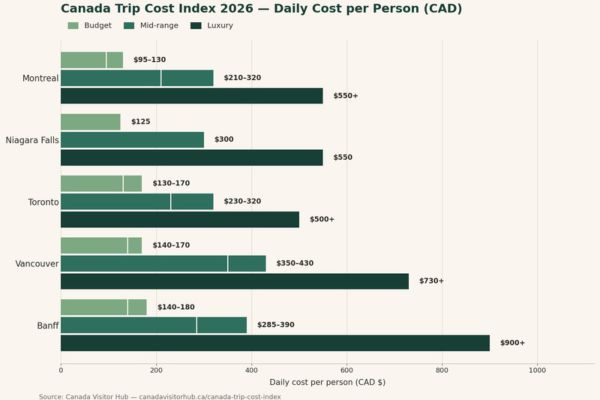
The version most people are actually imagining sits in the middle. A decent downtown hotel room — call it $225 a night, which hurt to type — does most of the damage, food lands somewhere around $75 a day if one of your meals is a proper sit-down dinner, and once you add sights, getting around, and the small stuff (coffee, a snack, the magnet you’ll defend at the airport), you’re looking at roughly $380 a day and something like $2,660 for the week. If you’d rather have this as tidy city-by-city tables, our full Canada trip cost research is where it all lives. I just don’t think in tidy form.
And then there’s the no-apologies version: about $705 a day, $4,935 for the week, with $415-plus going on five-star rooms and Rockies lodges and $140 a day on eating and drinking well. Perfectly lovely if you can swing it. Though it’s worth saying out loud that the lake looks exactly the same.
One thing the per-person numbers hide: go as a couple and the maths softens, because the room gets split. Two people doing the mid-range week together should land closer to $4,200 or $4,600 combined, not double my figures.
What my last Toronto week actually looked like
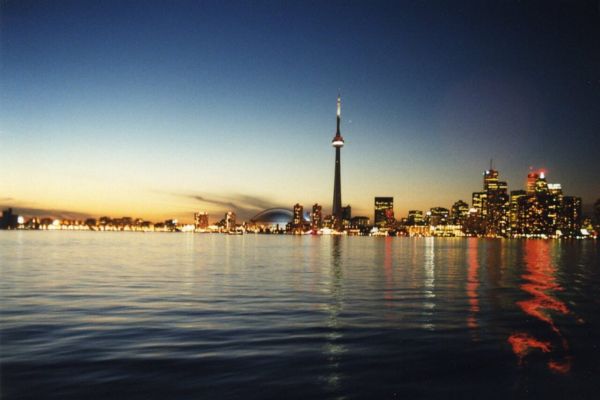
Abstract numbers are slippery, so here’s an actual week. My last Toronto trip ran seven nights at that same $225 hotel rate, which comes to $1,575, well over half of everything I spent, gone before I’d eaten so much as a bagel. Breakfast came from a grocery store near the hotel (berries, yogurt, the good bread, about $12 a day), ate lunches that ran sixteen to twenty-two bucks and dinners that averaged out to a $45-ish nightly splurge once tax and tip had their cut, and food for the week came to $525. Some days were cheaper. One involved an ill-advised amount of poutine at midnight and was not.
Getting around and doing things shook out like this: the airport train was $12.35 in ($9.25 on my PRESTO card), transit day passes were $13.50, and transport averaged about $30 a day, $210 all-in. Sights averaged $35 a day — $245 across the week — which covered the CN Tower at $47, a boat ride out at Niagara Falls for somewhere in the $35 to $40 range, a museum or two, and a lot of free walking in between. Then $105 of pure miscellaneous.
Total damage: about $2,660, plus a return flight from New York that cost me $382 US last September (call it $530 Canadian). Coming from Europe instead, expect something in the $600 to $900 zone in the shoulder months.
But Toronto is not Canada, price-wise, it’s just the convenient example. Halifax was the gentlest place in my spreadsheet — a mid-range day there sneaks in under $260, with a waterfront room around $145 and seafood dinners that would cost double on the other coast. Québec City hovers near $290 a day, helped along by Old Town rooms around $165 and those glorious fixed-price lunch menus.
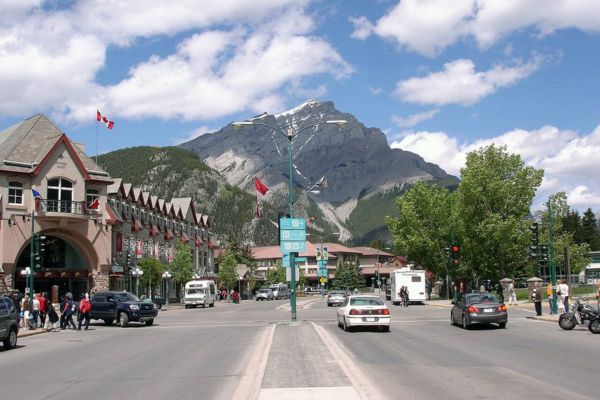
Toronto, Vancouver and Montréal all squat in the $350 to $400 band, the hurt concentrated in the hotel line, same as ever. And then there’s Banff, out on its own at roughly $440 a day — call it a quarter to a third pricier than Toronto for the same style of trip. A plain mid-range room cost me $312 a night in July and about $140 in late October, and the same pasta costs five to eight bucks more than it does in Calgary. Banff in July is worth it and I will die on this hill, but book the room in February.
The ambushes
Now the stuff that catches people out, because none of it is printed on the price tag. Canadian shelf and menu prices are quoted before tax, and the tax itself runs anywhere from 5 percent to 15 depending on which province you’re standing in. Hotels pile on extra: in Toronto you’re paying 13 percent HST and then a 6 percent municipal room tax on top, which is how a $199 room quietly becomes $232 at checkout. I just round every room rate up by a fifth in my head now. Saves the flinch.
Tipping is the other one. Eighteen to twenty percent on the pre-tax bill at sit-down places is simply what you do here — I still think about a Montréal dinner where $68 worth of food turned into $88 by the time the card machine made its way around the table. Every meal. Every day. It adds up to real money by the end of a week.
And then there’s the sheer size of the place. People budget for Canada like it’s a European country, and it very much is not one. Flying from Toronto to Vancouver can run $250 to $400 each way, last I checked — sometimes pricier than the ticket that got you into the country in the first place. Before you book a domestic hop, look at open-jaw routings instead — into one city, home from a different one. That trick once saved me about $90 and a tedious backtrack. Trains are the romantic option and priced like it, $150 to $300 between Toronto and Montréal, while the bus does it for $30 to $50.
Coming from a warm climate between November and March? Budget for boots and proper layers, because you will buy them. Who budgets for boots? Nobody. Then they arrive in January. Downtown parking will take $25 to $40 a day off you if you let it, and if your bank takes its 2.5 or 3 percent cut on every foreign transaction, that’s roughly $75 gone from a $2,500 trip before you’ve noticed. None of these appear in anyone’s brochure.
Zoom out and the pattern is almost boring: it’s the bed and the wheels. The hotel eats close to 60 percent of a mid-range day, wheels come second — a summer rental car in the Rockies goes for $85 to $120 a day before you’ve put a litre of $1.62 gas in it — and dinners do most of the food damage, because nobody’s blowing the budget on breakfast. Admissions, the thing people anxiously save up for, are usually the smallest slice. The headline scenery is free.
So, the habits that keep my own totals from embarrassing me. Shoulder season is the big one — late spring and September into early October shave 30 to 40 percent off hotel rates while the country is still showing off. Doing the national parks? Grab the Discovery Pass at the first gate: $83.50 for one adult, $167.50 for a carload, a full year of 80-odd parks and historic sites, and since a single day’s entry at Banff is $12.25 it’s paid for itself within the week.
I eat on a rhythm, too — grocery breakfast, market lunch for $15 or $20, one real dinner — which saves me somewhere around $40 a day, and in Québec City I’ll hunt down the $20 to $28 set lunches like it’s a sport. A $12 to $16 poutine at midnight remains, legally, a food group.
Skip the rental car in the big cities entirely. I once ran the same five Toronto days both ways, with a car and without, and car-free came out ahead by $300 and change — parking is a racket and the transit’s fine.

Book Rockies rooms three to six months out because those towns genuinely sell out, but for city hotels, four to six weeks ahead is the sweet spot; watching Toronto prices for a month, the dip showed up almost exactly at week five. And front-load the free stuff. The ferry out to the Toronto Islands is $9.57 return, and after that the beach costs nothing. So does the seawall in Vancouver, the boardwalk in Halifax, an entire afternoon getting lost in old Montréal. Some of my cheapest days in this country have been my favourite ones, and I don’t think that’s a coincidence.
Usual caveat, and I mean it: prices wobble. Hotels reprice constantly, passes go up, and my spreadsheet is a snapshot from October 2026, not a promise. Use these numbers to build the shape of a budget, then check the big items against live prices before you commit.
A Canada Trip Cost Summary
Canada will take exactly as much money as you let it, and not a dollar of it has to be a surprise. Decide what the bed and the wheels are worth to you, let the rest follow, and save your flinching for the weather. It’s colder than you think. The trip, though? Worth every line of the spreadsheet.